
You are reading Molekyl, finally unfinished thinking on strategy, creativity and technology. Subscribe here to get new posts in your inbox.
About a hundred years ago, an electrical generator broke down at a Ford plant in Michigan. The Ford engineers worked day and night to locate the problem. Checked the facility centimeter for centimeter, without any luck.
Finally, the engineers reached out to General Electric, who sent its best man to Michigan: Charles Proteus Steinmetz. A small German with a hunchback and a limp, whose name is often considered among the big thinkers of his time.
Steinmetz arrived at the plant, and got to work. He listened to the generator, and scribbled on his notepad. Listened some more, scribbled more, and so on.
After a period of intense listening and scribbling, Steinmetz asked for a ladder. He placed it next to the generator, climbed it, and made a chalk mark at the side of a panel on the generator. When he made it down again, he told the Ford engineers what to replace behind the mark, and left.
The engineers did what Steinmetz said, and the generator worked again.
When Henry Ford later received an invoice of $10,000 from General Electric he asked for it to be specified. After all, this was quite a lot of money at the time. Steinmetz did: Making a chalk mark, $1. Knowing where to set the mark, $9,999.
You might have heard a variant of this story before. I have heard several, including one where Steinmetz used a hammer to whack the machine into working again.
Exactly how the story played out is, however, beside the point. Which is to illustrate the high potential value of deep expertise. The value of doing the right things, versus doing things right.
But the question I am sitting with when I think about this story today is how AI would fit into it. Is AI something that would replace the kind of expertise Steinmetz brought to the table? Or is it something that would complement it? And in any case, why?
The gap at work
In my previous post with Alexander Selvikvåg Lundervold, we discussed implications of AI for higher education. Our starting point was that higher education is all about the why-questions, building the wisdom located at the very top of the knowledge pyramid.
In building our arguments, we suggested a simple equation for wisdom, where:
Wisdom = experience × reflection on that experience.
Since higher education falls short on experiences compared to real life, its role and aspiration is to facilitate for wisdom accumulating through amping up the reflection term of the equation.
At work, the wisdom equation is the same, but the problem is different. In any job, experiences are abundant. We do things all day, every day. What we do much less of, is to reflect on those experiences. To stop and ask why we are doing what we are doing, or whether it’s the right thing to do at all.
But the lack of deep reflection at work isn’t because we are lazy. It is more structural than that.
Just think about what your own job actually is. Most likely a pre-specified role, embedded in pre-specified structures and processes. In my role as a professor, I am expected to deliver certain courses, supervise students for certain tasks, do research within a certain field, and sit on committees with certain goals and tasks.
I was hired to do certain things right, and metrics like course evaluations and publication points measure how I am actually doing them.
At first glance, this might seem like a perfect set-up for wisdom-building through reflection in practice. We do things, use performance metrics to see if it works as planned, reflect on any differences, and then improve based on our learnings.
But this isn’t the deep reflection on experiences of the wisdom equation. It’s something else.
The two loops
To explain why, let’s first simplify an organization into the figure below. Its strategy lays out a direction of what it should do, it does things in this direction, and it gets certain results. Results are then compared to the initial aspiration, and adjustments are made to make the next round of doing better than the first. And so it goes.
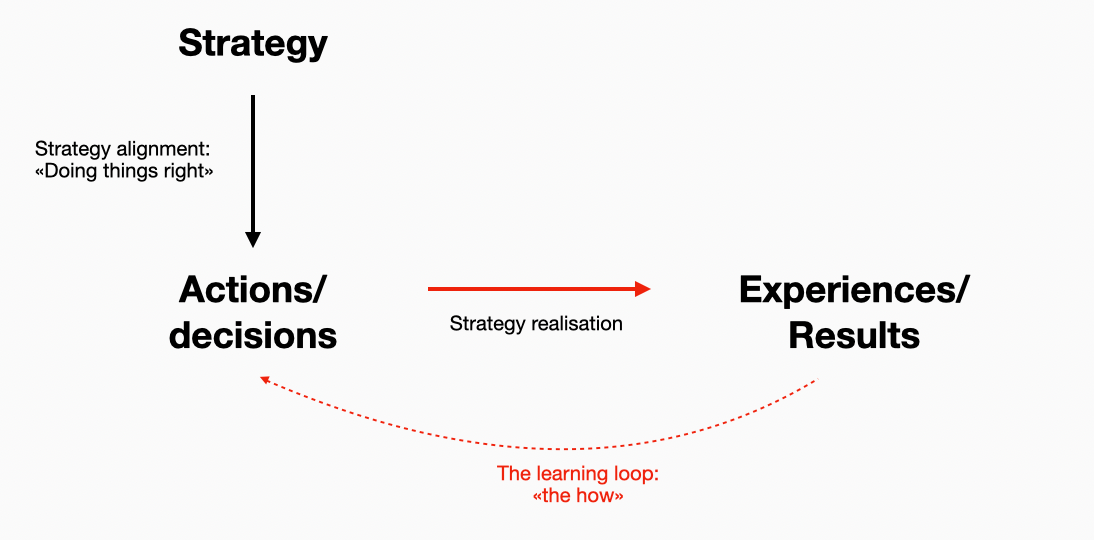
In strategy we call this learning loop local search (more on this here). It’s reflection on the how, where actions produce results, and results adjust actions. It’s fast, incremental, and measurable. It’s the constant improvement the Ford engineers did daily at their facilities in Michigan. It’s doing things a little more right every day.
It’s a learning loop, but not a wisdom loop. The reason is that it for the most part happens downstream of strategy. Strategy sets the right thing to do. The learning loop works to do those things right. A system for rapidly improving the how, not to invite deeper reflection on whether we are doing the right things in the first place.
For the latter, we need a second, higher order feedback loop. One that is too often missing in many organizations: the wisdom loop.
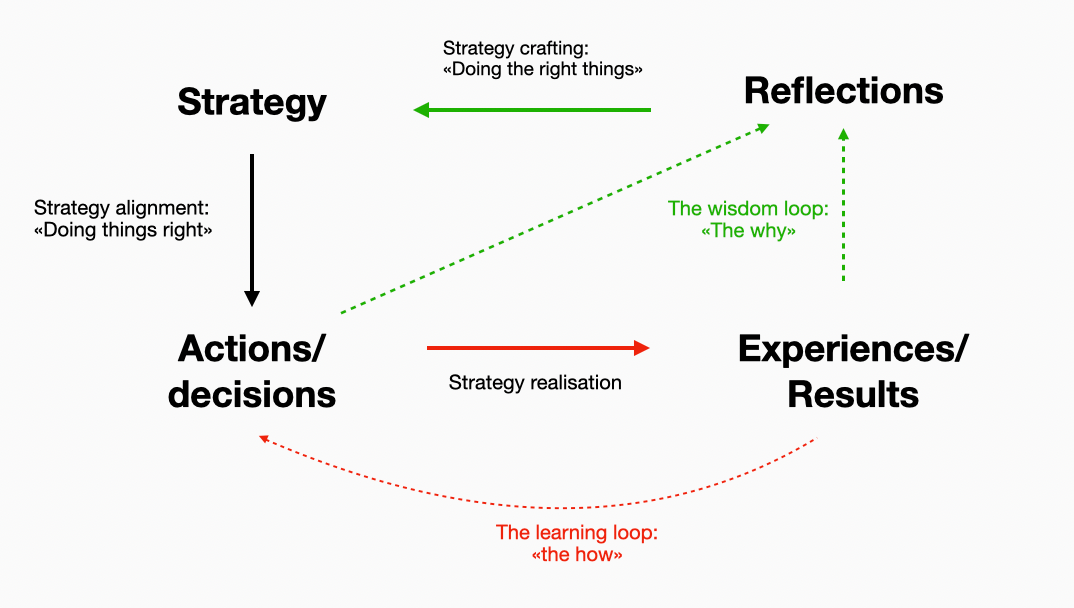
The wisdom loop is the other loop in the figure above. Here experiences in the form of actions and results feed into reflections about the deeper why-questions of the organization, not only about the how. It’s where we ask the bigger and harder questions around whether we are doing the right things. And it’s where reflections on our experiences can lead us to fundamentally reshape a strategic direction.
The idea of adding this second loop, turning the organization into a double-loop system, isn’t new. But despite first appearing in the 1970s, its broad deployment still seems scarce. The reason? Probably because the wisdom loop is slow, hard to measure and challenging to install in practice, while the learning loop is often incredibly effective.
Stooped by the loop
In the daily grind of organizations we tend to focus more on the learning loop of doing what we do a bit better every day, than to ponder on the big directional decisions.
Over time, such constant, gradual improvements of processes, norms, structures, incentive systems, conventions and leadership principles, make organizations better at doing their things right. Which is good.
The problem is that the same fine-tuned processes and structures produced by the learning loop, also become antibodies against the higher-level reflections of the wisdom loop intended to question whether we do the right things in the first place.
A Ford engineer improving uptime for the fourth week in a row? That is goal fulfilment. A Ford engineer spending a month thinking hard about whether they do a certain process in the right way or not? That’s a clear dip in short-term performance.
In other words, the more effective the learning system designed to keep the machine running and constantly improving, the harder it becomes to hit pause and question what the machine is running toward. Which is why deep reflection on the why becomes relatively rare in the workplace.
It happens, but often because of a bigger system breakdown. When a crisis hits, like a disruptive startup suddenly starts stealing customers, a new technology comes bustling in, or in the case of Ford, a flawed generator that stops the production line, the friction might become high enough to overpower the antibodies and force us to consider the deeper why.
But since such episodes are more the exceptions than the rule, the antibodies of the learning loop tend to out-crowd the deeper strategic reflection of the wisdom loop.
What then happens when we throw AI into the mix?
AI turbocharges the wrong loop
Out of the box, AI agents are learning loops on steroids. Capable, tireless, masters of the what and the how. Give them a problem, and they look to the past for the protocol. They are the doers running local search at superhuman speed.
If the direction of this doing is right, this is undoubtedly a good thing. The issue is that the introduction of the very same AI capabilities also mean the likelihood of our old ways being the best is lower than before.
Many of us know this. But when we see others bragging about having agents working through the night, we don’t take the time to reflect on what the new right thing to do is. Instead, we rush to set up our own agents to expedite our own doing within the established strategy.
If the agents end up not doing the right things, it’s at best token-burning theatre. Competent doing, with few real results. At worst, it’s competent doing at speed down a direction we should have questioned.
Accelerating the learning loop without the wisdom loop increases the danger that we run faster in the wrong direction, and converge on the wrong thing. Local search finds the local optimum and locks us there with increasing confidence. The faster the learning loop spins, the more certain we become that we are doing things right, and the less likely we are to notice if we are doing the wrong things.
This means that the gap between doing things right and doing the right things doesn’t stay the same with AI. It widens.
The flip
Fortunately, the same machine that may dig us down a hole can also help us up again to see the landscape more clearly.
AI agents can be more than doing machines. As for higher education, they can with a flip become reflection machines. A system that helps us ask the questions the doing agents often suppress.
The reflection machine can sit with us and interrogate whether the thing we are about to set hundreds of agents loose on is the right thing at all. Help us think harder about the why-question. And create enough friction that we need to really think something through.
It’s the same flip as in the education piece. Turn the answering machine into a questioning machine. With the purpose of installing the wisdom loop.
The difference, however, is that in education, someone is (on paper at least) responsible for designing the reflection. A professor tasked with designing a curriculum and a learning outcome. At work, that responsibility falls on leadership for the big strategic decisions, and the rest of us for the others.
And that’s harder than it sounds, because the two loops don’t necessarily compete on the same terms. The learning loop generates one type of evidence. Every improving KPI, every efficiency gain, every agent completing a task faster than before reads as proof that the current direction is working. In contrast, the wisdom loop has murkier signals, leaving more up to the receiver to interpret whether it points to the current direction being the wrong one.
This is a point I discussed in this post: the evidence for staying the course is usually cleaner than the evidence for changing it. And the more the learning loop delivers, the less actively we tend to look for evidence that might contradict our direction.
Which is exactly why installing the wisdom loop requires nerve, and not just a clear mind. It means to reflect on the more ambiguous signals, while the clear ones are telling you everything is fine.
But it’s worth a try. Because when you get it right, the abundance of experiences at work really comes in handy. At work, both terms of the wisdom equation are in place. And not just one as in higher education. Done right, the two loops start to feed each other.
Wisdom decides what the agents should be doing. The agents execute, and help generate experiences at a faster pace than ever. A reflection machine helps pull the why out of all that experience. And your sharper understanding of the why decides what the agents do next, hopefully better than before.
The ideal is a system where the wisdom loop feeds the learning loop, and the learning loop feeds the wisdom loop. A system that compounds on itself.
What would Steinmetz do with AI?
Going back to Steinmetz, I don’t think his wisdom would be substituted by AI. Simply because it’s nested in his ability to ask the right questions. When the cost of doing things right falls, knowing the right thing to do becomes worth more than ever. Steinmetz’ genius and wisdom complemented with AI, could easily mean that his chalk marks would cost millions today. Making him an intellectual superman.
But the most interesting part is what AI would enable for the smart, experienced and capable Ford engineers. Those stuck in the learning loop. Those who have the ability to ask why, but operate in a system that makes it structurally hard to actually ask that question.
That’s most of us.
AI won’t turn us into Steinmetz, but it can give us a way into the wisdom loop that was harder to come by before. AI can be a reflection partner that sits with us, pushes back, forces us to think about the why-question, even when every KPI and every deadline is screaming at us to just keep doing.
There are thousands of why-questions sitting unasked in every organization that don’t require genius. They just require someone to stop and ask them. Why do we do as we do? Could it be done differently? And why would that be better?
Questions helping us point all the increasingly potent doing in the right direction.
Which takes us back to the chalk mark. The chalk mark at Ford’s generator was Steinmetz signing off his wisdom. Now it’s our turn to pick up the chalk and reflect on where we want to leave marks of our own.