
You are reading Molekyl, finally unfinished thinking on strategy, creativity and technology. Subscribe here to get new posts in your inbox.
I am a sucker for new ideas, and always have been. Over the years, this has resulted in a metaphorical drawer increasingly full of ideas.
While my drawer plays a central role in my own creative process, I have also felt a bit melancholic about it. Around all the ideas and good intentions that I never realized, and probably never will. Because the inflow of new ideas so greatly outpaces the speed at which my limited time and attention allows me to explore and execute.
This was the story of my drawer until one day when AI came along. Suddenly, I could see myself removed as the constraining factor for idea realization, simply by delegating execution to agents.
However, my enthusiasm lasted only till I put the theory to the test, and reality slapped me in the face with something I hadn’t considered. The Zappa cost.
The promise of the drawer
When GPT-4 launched in the spring of 2023, most discussions revolved around how AI could answer more and more sophisticated questions. I, on the contrary, spent most of my time exploring the creative side of the technology.
Armed with a chatbot in my pocket, I explored ways to accelerate my own creative thinking. I captured fleeting thoughts on the fly and turned them into elaborated streams of thoughts. I explored complex ideas in hours that would normally have taken me days or weeks to think through. And I paused explorations only to pick them up again months later, when new sparks had appeared. Without losing much track in between.
All this experimentation taught me a great deal about LLMs and how to work with them, and it helped fill my drawer faster than ever. Which was a rush that only got me even more eager to explore new ideas.
Over time, as a steady stream of ideas poured into my increasingly bustling drawer, the melancholy around all the unrealised ideas started to sneak in again. Which got me thinking: Could AI also be used to realize more of the unfulfilled potential of my drawer?
It sure looked like it. Increasingly capable tools combined with more sophisticated agent capabilities seemed perfectly suited to breathe life into dormant ideas. Just outsource the doing to agents, and voila: Half-baked essay ideas would turn into full write-ups. Short film concepts would become actual short films. And app ideas would become actual apps.
Maybe I once and for all could remove the constraint that held back the realization of so many of my ideas: my limited time and attention.
Bringing a Corpse to life
In Easter this year I decided to put this theory to the test. I was up in the mountains with my family, and one evening after everyone had gone to bed I decided to have AI bring a dormant idea to life.
I skimmed through my drawer for candidates, and eventually stumbled upon an idea from my junior high years: to start a black-metal-school-brass-band called “Corpse.”
At the time, I found both the name (which is a pun on “korps”, the Norwegian word for brass band) and the absurdity of melting these two genres very amusing. Revisiting the idea 25 years later, I still found it fun.
So I gave Claude the full idea pitch, and tasked it to create lyrics and a prompt for Suno. While I was at it, I also had it craft prompts for logo, visual profile and band photos, that I could use in other tools. And a full conceptual story around the fictitious band.
Shortly after, Claude delivered. Full prompts for Suno, lyrics, conceptual write-up, prompts for logo and prompts for band images. They were all really good. All I had to do was to paste the prompts into some other tools and Corpse would be born.
There was only one problem:
I didn’t do it.
I just had to fix some things first.
The generated Suno prompts leaned in a different direction than the one I originally had in mind. The lyrics had some fun lines and twists, but lacked the conceptual edge and the tongue-in-cheek absurdity I felt should be at the heart of this project. The logo prompt seemed too clean, while I wanted dirty. And the prompts for the band image lacked the sweaty, claustrophobic feel of the school gym halls where I had envisioned “Corpse” would be playing.
Claude’s delivery was a realization of an idea. It just wasn’t the realization of my idea.
So I got to work. It started as a small fix, but quickly turned into something more. I revised the music style prompt. Played around with song concepts. Did research on brass bands and listened to old black metal favorites from the 90s for inspiration. Revised the prompts and concepts. Had Claude write out lyrics. Revised and rewrote lyrics. Tested in Suno. Wasn’t happy. Rewrote prompts and lyrics. Tried again. Countless times. Looked at old black metal videos on YouTube. Generated visuals. Changed the prompts. Generated new visuals.
I continued with such refinements over several evenings, until it finally felt right and Corpse rose from the drawer:
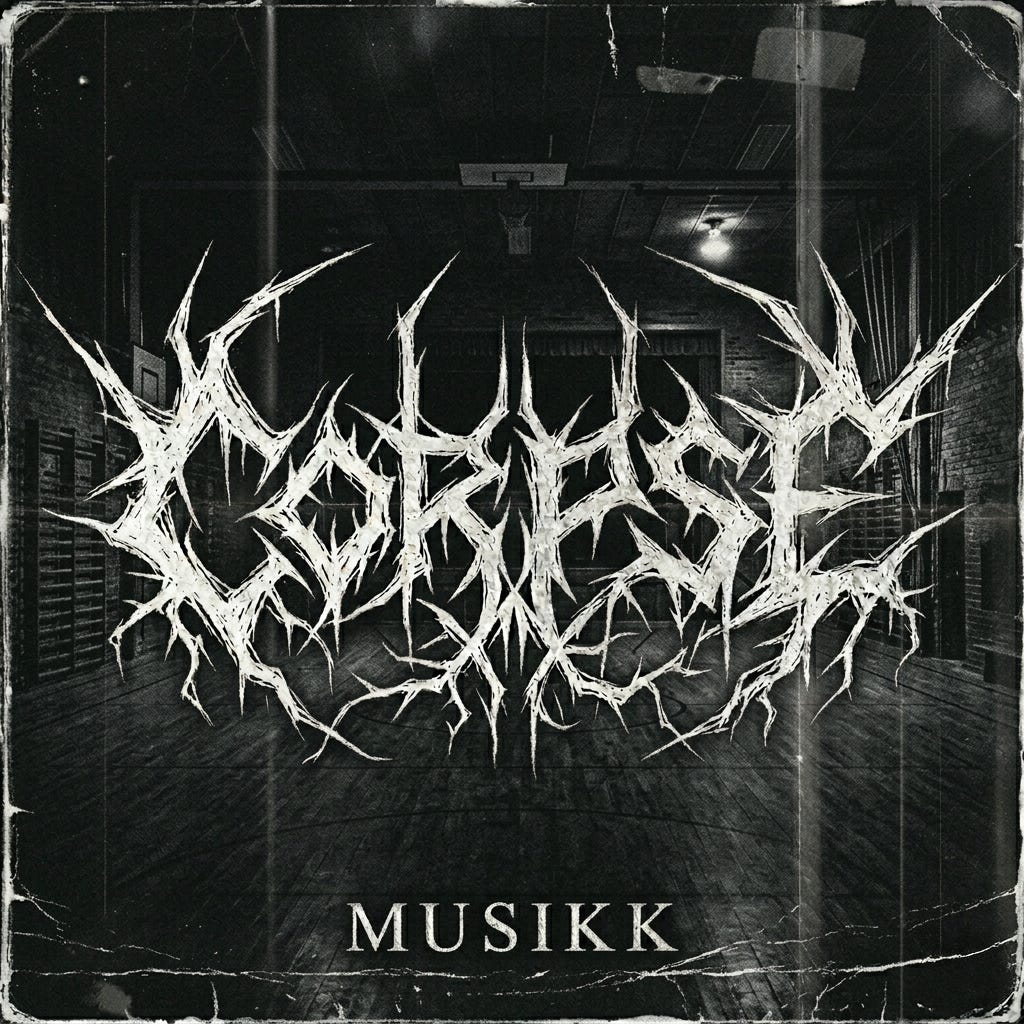
It just didn’t happen as I had planned.
My intention was full delegation to AI. The reality was a full-blown vacation project where I worked with and for AI, instead of having it work for me.
That said, the result of this experiment wasn’t really a surprise. Because it surely wasn’t the first time something similar had happened when I had tried to delegate idea execution to AI (or someone else for that matter).
Often when I do, the AI usually delivers something that is good and… wrong? Which makes me either send the idea back into the drawer, or start working more of it out myself. That is, I end up putting myself back as the constraint of the equation.
Like I once again did when I got the “brilliant” idea of making a music video for one of the Corpse-songs for this very post. The exact same story, all over again:
When pondering the why behind this consistently peculiar behavior, it struck me that an old hero of mine, namely Frank Zappa, might hold the answer.
The Zappa cost
A few years ago, I watched a documentary about Frank Zappa. In it, his wife described how Zappa never judged a song on its commercial success or on how other people liked it. He judged it solely on how close he felt a song honored the feel or vision of his original idea. If the finished work felt like the right representation of that initial spark, it was a success. If it didn’t, the work wasn’t done. And Zappa continued to obsess over it, even if everyone around him considered it done long ago.
After learning this, I remember thinking that Zappa’s problem also was my problem. The realization of an idea I care about isn’t right until it is.
Which can explain why I can be annoyed with a talk delivery that an audience liked, and be very happy with one they didn’t. Why I can spend a day working out a visual solution to one single point for a talk, when no one would notice if I had just gone with my first attempt. And why my attempt to delegate the realisation of the Corpse idea to AI failed. Twice.
There is a cost attached to betraying one’s own creative vision. The cost of seeing the realization of a project not doing sufficient justice to the original vision and feel when you first got an idea. Let’s call this the Zappa cost.
When the Zappa cost is high enough, delegating work to others, including AI, doesn’t make sense anymore. Then it is cheaper to take back some or all of the control, put in the hours, and create something that gets it right.
The Zappa cost can therefore help explain what from the outside may seem like erratic behaviour. Like not delegating work to AI when it’s obviously faster, cheaper or even better. Or doing endless iterations on work that others think is just fine.
From the outside, delegating the Corpse project to AI was an absolute no-brainer. It was just a silly idea, with no real purpose. It takes a couple of minutes to create six songs in Suno, compared to days doing it the way I did (or worse, weeks or months if I were to make them the old way myself).
From the inside, it’s different because of the Zappa cost. When we take that into account, it’s no longer a simple choice between doing it yourself or delegating to cheap, fast and good AI. It’s a choice between delegating to AI while incurring the Zappa cost, or getting rid of the Zappa cost by doing it with heavier human involvement and control.
For many low-stake, or externally motivated ideas, the Zappa cost is small. At least for me, as there just isn’t any deep personal vision or idea to betray anyways.
For ideas that are intrinsically motivated, the Zappa cost can be considerable enough not to delegate when that looks like the only sensible thing to do from the outside. Like I did with the Corpse idea.
While the difference between the inside and outside look doesn’t really matter when I fiddle with personal projects over my holidays, it certainly does in the setting we spend most of our time in. At work.
Zappa at work
At work, the invisible nature of the Zappa cost is doomed to create problems, misunderstandings and even suspicion.
Just envision a manager who knows that an AI agent can generate a full presentation deck in five minutes, and then observes that one of her team members spends two days on it instead. From the outside, this might look like a clear inefficiency, a failure to adopt the tools, laziness, or even resistance to change.
But the team member might not be polishing for the sake of polishing, but working hard on closing the gap between what the AI delivered and what they originally envisioned. For the employee, that gap may be as real and uncomfortable as it was for Frank Zappa. For the manager, it’s not anywhere in sight.
The cruel part is that both might be right about their cost-benefit analyses, simultaneously. From the vantage point of the manager, the benefit of AI delegation is a no-brainer. For the employee, it might not be. Because the Zappa cost of betraying their own vision is substantial enough to tilt the conclusion in the other direction.
This creates a genuine management problem. When do you overrule someone’s Zappa cost and when do you not?
While every idea obviously doesn’t deserve the hours it might take to close the gap between vision and implementation, the decision is more complicated than evaluating the cost-benefit of the output. Because the same drive that makes someone refuse to accept work that doesn’t honor their original vision, might also be the very thing that makes their best work stand out. Optimize away the Zappa cost, and we might optimize away the motivation and ownership that produced the vision in the first place.
The Zappa cost might also help explain a pattern I explored in this post: that highly skilled people seem more likely to stay in high-control modes when working with AI, while less skilled people are more likely to vibe away with their newly found tools. If highly competent people in a domain are more likely to have built a vision for how the final work should feel, then expertise might contribute to making the distance between AI output and that vision larger, and more painful to accept. For a novice without a clear vision, there is no deep original idea to betray.
More broadly, as the speed, accuracy and quality of AI continue to improve, the outside expectations of what we should delegate to AI will likely grow. Further increasing the tension in knowledge work between “you could have just delegated this to AI” and “but it wouldn’t have been right”.
Finally
While the Zappa cost and the associated problem it creates for delegation clicks for me, I am sure it doesn’t for all. Which is fine. We are all wired differently, and some are more obsessed with their own ideas than others.
That said, I still think it’s useful to be aware that people around you might see and feel things differently. At least it gives you an alternative explanation for why your designer continues to obsess over that design you thought looked good on first draft, while the same designer is also perfectly happy to just have AI write all his emails and management reports to you.
For some, the Zappa cost is as real as it gets for work they care about, and nonexistent for other types of work.
But the Zappa cost can also help us better understand what work matters for each of us. Consider this very post. The first draft took me half an hour to write. Now, four weeks, 20+ hours of iterations later, and countless hours spent on creating a silly music video for a fictitious black brass band to make my running example more vivid, the piece is finally feeling right.
Efficient? Certainly not.
Worth it? For me it was.
Even if my employer might see it differently.